Easy read and translate

Adult-child interactions
- Professionals and Clinicians
- Speech, language and communication

An introduction to speech, language and communication
ShREC
The ShREC approach is a helpful framework for supporting high‑quality interactions with all children. It can be particularly helpful for spotlight children.
ShREC stands for:
- share attention
- respond
- expand
- conversation
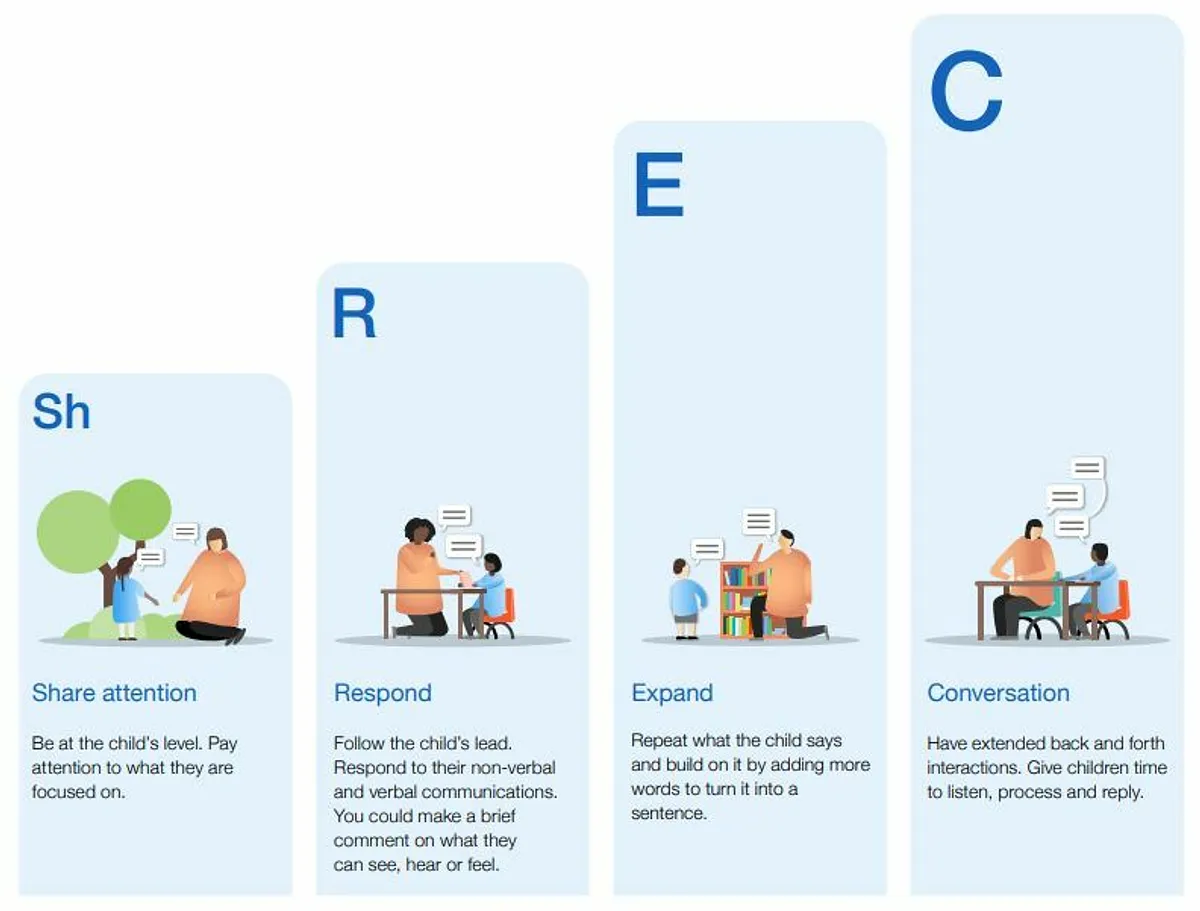
Share attention
Building communication starts with joining a child or young person in whatever has captured their interest. They may be playing, reading, working on a project, or scrolling through something on a device. Showing genuine curiosity signals that you value their perspective and want to connect.
Position yourself near them to notice what they are doing, thinking or expressing. You may need to position yourself physically next to younger children. With older children you may just need to enter their space and show interest. This shared focus lays the foundation for meaningful interaction at any age.
Take time to observe, wait and listen. By slowing down, you give children and young people space to communicate in their own way and at their own pace. It also allows you to notice when a child or young person is not yet engaged and gently encourage them to join in or connect with others.
Respond
During a shared moment, your responses should reflect their personality, preferences and needs. Effective responses are warm, encouraging and aimed at helping them feel supported.
Allowing time for a response is important. Pausing gives the child or young person time to think, process and take their turn. A useful strategy is commenting. This means describing what the child or young person is doing, seeing or experiencing, rather than only asking questions.
Responses don’t always need to be verbal. Things like eye contact, facial expression, body language and attentive pauses can communicate just as much as words. When using spoken responses, you might:
- describe what you’re noticing
- acknowledge their efforts
- link it to previous discussions or learning
Or you may simply show that you understand their message, whether it’s spoken or shown through actions.
Expand
As you and the child or young person begin to take turns, you can help build their communication by adding to what they say or show. This involves following the child’s lead and offering slightly more complex language than what they have used. This might be one extra word, a fuller sentence or a slightly more detailed idea. This applies to all ages, from toddlers who use single words to older children who may benefit from support in expressing more complex ideas.
For example, if a child says “dog,” you might respond with, “Yes, a little brown dog.” Or, “The reaction was kind of weird,” you might respond with, “It was unusual. The mixture changed colour really quickly, which shows a fast chemical reaction.”
What you choose to model should be guided by your understanding of the child’s current communication level. The aim is not to correct, but to provide a helpful language model that stretches their skills just a little.
Conversation
The end goal is a genuine, sustained exchange. This may be a playful back-and-forth with a toddler or a thoughtful discussion with a teenager. Conversation gives children and young people the chance to:
- practise language
- explore ideas
- receive responsive feedback
To encourage meaningful exchanges, use comments more often than questions. Observations, reflections and reactions help keep the conversation flowing without making the young person feel tested. When you do ask questions, use open ones. For example, “What happened next…?”, “How did that happen?”. Open questions invite deeper thinking and give them space to share more.
Some approaches, such as giving lots of instructions, asking quick closed questions or using general praise, may be necessary at times. However, these tend to offer fewer opportunities for building language, so it helps to balance them with more responsive interaction.
Last reviewed: 7 May, 2026